Do Cats Need Elevated Bowls Too? Whisker Fatigue Explained

TLDR:
Elevated bowls are not just a dog thing. Cats can benefit too, mainly because a wide, raised bowl keeps their whiskers from brushing the sides, which some vets link to something called whisker fatigue (also called whisker stress). The science here is still thin, so we will not oversell it, but the logic holds up: a wider, shallower, slightly raised bowl also supports a more natural neck posture for cats, especially seniors and cats with joint or swallowing issues. If you have a multi-pet home, the same feeding station can often work for both your dog and your cat.

What is whisker fatigue in cats?
Whisker fatigue is the term some veterinarians use to describe sensory overload when a cat's whiskers repeatedly brush against the sides of a narrow bowl. A cat's whiskers are packed with nerve endings, and constant contact while eating can make some cats stressed, hesitant to finish their food, or reluctant to approach the bowl at all.
It is worth being honest about where the science actually stands. Whisker fatigue is a relatively new and still debated topic. There are almost no controlled studies proving it exists, and the term shows up mostly in veterinary opinion pieces and clinical observation, not peer-reviewed research. Oklahoma State University's Veterinary Medical Hospital has weighed in on the topic and recommends a flat surface or a bowl wide enough that the whiskers do not touch the sides, as general good practice for cats who seem reluctant to eat.
So: not proven, but not dismissed either. It is a plausible, low-risk thing to try if your cat picks food out of the bowl and drops it on the floor, hovers over the bowl without eating, or seems more interested in food that has spilled onto a flat plate.
Does an elevated bowl actually help with whisker fatigue?
The two problems (whisker contact and posture) are solved by different features of a bowl, and it is worth separating them:
Whisker contact is mostly a width and depth issue. A wide, shallow bowl keeps the whiskers clear regardless of height.
Neck posture is a height issue. Raising the bowl reduces how far a cat has to crouch or bend to eat.
A well-designed elevated feeding system solves both at once: wide enough insert to clear the whiskers, and enough height to bring the food closer to a natural head position. That combination is why elevated, wide-mouthed bowls come up so often in whisker fatigue discussions, even though the elevation itself is not the part treating the whisker issue.
Which cats benefit most from elevated feeding?
Not every cat needs this. But a few groups tend to benefit more consistently:
Cat type | Why elevation helps |
Senior cats with arthritis | Less pressure on elbows, shoulders, neck and spine while crouching to eat |
Cats with megaesophagus | A raised or upright feeding position can help food move down more easily |
Flat-faced breeds (Persians, Exotic Shorthairs) | Similar logic to brachycephalic dogs: less strain reaching down to a low bowl |
Multi-pet homes with a dog and cat | One elevated station can be sized for both, instead of two totally different setups |
Cats who scoop food out and eat off the floor | Often a sign the bowl is too narrow or too deep, not that the cat dislikes the food |
If your cat is young, healthy, and eats normally from a standard bowl, there is no urgency to change anything. This is a "try it if there is a reason to" recommendation, not a blanket one.
What did a vet physiotherapist say about this?
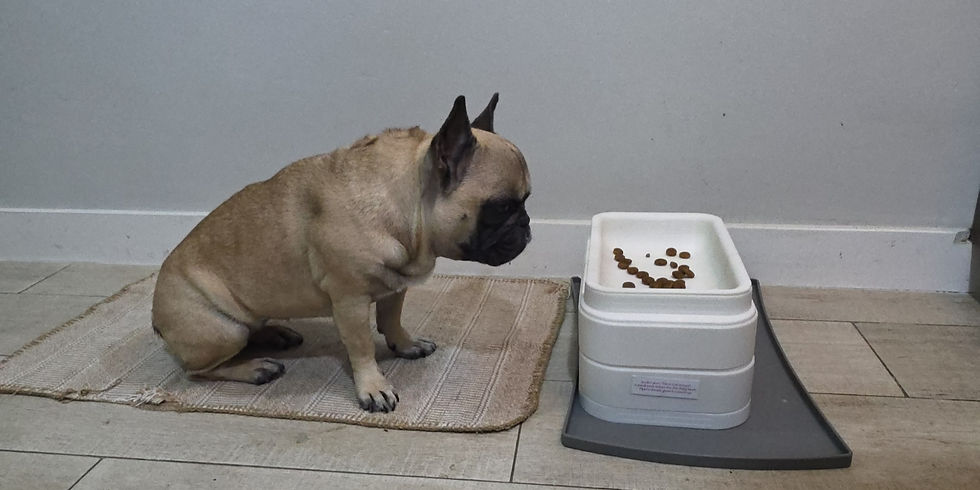
We had Tash, a veterinary physiotherapist at Umm Suqeim Vet Centre in Dubai, review our elevated feeding system, Élevé, with our dog Piper on camera. Her take was not limited to dogs:
"This is going to be a real game changer, not only for dogs, but for cats..."
— Tash, Veterinary Physiotherapist, Umm Suqeim Vet Centre
"There's nothing about it I don't like."
> — Tash, Veterinary Physiotherapist, Umm Suqeim Vet Centre
That is the honest core of our whole approach: we built Élevé around Piper's specific needs (she is a rescue French Bulldog with a cleft palate history, a luxating patella, and high arthritis risk), but the underlying idea, that posture at mealtime matters, is not species-specific.
How high should a cat's bowl be?
Vets generally point to a range of about 3 to 6 inches, depending on the cat's size. The goal is the same as it is for dogs: the neck should stay in a neutral, comfortable position while eating, not stretched down or craned up. If you are estimating at home, the bowl rim should sit roughly level with or just below your cat's shoulder when they are standing normally.
Is this a real health issue or a marketing trend?
Both things can be true. The posture argument (less strain on the neck, shoulders, and spine while eating) has real anatomical logic behind it, and vets recommend elevated feeding for specific conditions like arthritis and megaesophagus. Whisker fatigue specifically has weaker evidence behind it: real enough that vets discuss it, not proven enough to call it settled science.
We would rather tell you that plainly than oversell it. If your cat shows signs of whisker discomfort or you have a senior or flat-faced cat, a wider and slightly elevated bowl is a low-risk thing to try. It is not a guaranteed fix for every eating issue, and if your cat is refusing food, losing weight, or seems to be in pain, that is a vet visit, not a bowl swap.
FAQ
Is whisker fatigue in cats scientifically proven?
Not fully. It is a widely discussed concept among vets and cat owners, but there is very little peer-reviewed research on it. Most of the evidence is clinical observation and anecdote rather than controlled studies.
What bowl shape is best for whisker fatigue?
Wide and shallow. The bowl should be at least as wide as your cat's face so the whiskers do not brush the sides while eating.
Do all cats need an elevated bowl?
No. Vets tend to recommend it for specific situations: senior cats with arthritis, cats with megaesophagus, flat-faced breeds, or cats who visibly struggle with a standard low bowl. A young, healthy cat eating normally does not need to switch. But speak to your vet.
Can one elevated feeding system work for both my dog and my cat?
Often, yes, especially with a modular or height-adjustable design where you can set the right level for each pet. That was part of the thinking behind building Élevé as an adaptable system rather than a fixed single-height bowl.
What are signs my cat might have whisker fatigue?
Pulling food out of the bowl and eating it off the floor, hesitating or pacing near the bowl before eating, or eating faster and more comfortably from a flat plate are the most commonly reported signs.
What height should I set an elevated bowl to for my cat?
Roughly 3 to 6 inches for most adult cats, aiming for the bowl rim to sit around shoulder height so the neck stays in a neutral position.
Sources
Oklahoma State University Veterinary Medical Hospital: Whisker Fatigue in Cats https://news.okstate.edu/articles/veterinary-medicine/2017/whisker-fatigue-cats
PetMD: Whisker Fatigue in Cats, What It Is and How To Help https://www.petmd.com/general-health/whisker-fatigue-cats-what-it-and-how-help
Cats.com: Whisker Fatigue, Does It Really Happen? https://cats.com/whisker-fatige
About the Author:
Mariska Nell is the founder of Tails & Tones and host of the Tails & Tones podcast, where she interviews veterinary specialists about canine comfort, mobility, and everyday care. She holds a Master's in Sustainable Design and a postgraduate qualification in Environmental Science, and lives in Dubai with Piper, a rescue French Bulldog and the reason Élevé exists.

Comments