Are Elevated Bowls Good for Dogs With Arthritis?

TLDR:
Yes, for many arthritic dogs an elevated bowl can genuinely help. Veterinary rehabilitation specialists and orthopedic surgeons often recommend elevated feeding for dogs with arthritis because it reduces the load on sore joints during meals. Floor-level feeding pushes more than 60 percent of a dog's body weight onto the front limbs, and a dog eats over 8,000 meals in an average lifetime, so that posture repeats a lot. An elevated bowl is not a cure and it does not replace veterinary care, but it is a low-risk, low-cost change that can make daily life more comfortable. If you have a large, deep-chested breed, talk to your vet first (see the FAQ on bloat below).
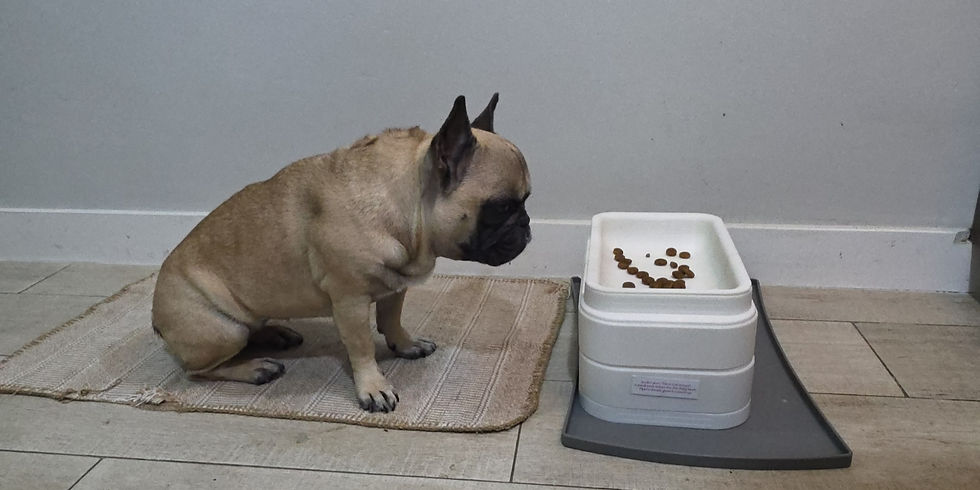
This guide looks at whether elevated bowls are good for dogs with arthritis, what the research actually shows, and how to know if your dog needs one.
Arthritis is one of the most common chronic conditions in dogs, and it shows up far earlier than most of us expect. Dr. Laurie McCauley, a pioneer in veterinary rehabilitation, shared on the Tails & Tones podcast that around 20 percent of dogs have arthritis by age one, and around 80 percent by age seven.
That number stopped me in my tracks. It means most dogs will spend a large part of their lives eating meals in a posture that either helps their joints or works against them. This post walks through what the experts I have interviewed actually say about elevated feeding for arthritic dogs, and what the honest limits of an elevated bowl are.
Why does feeding posture matter for a dog with arthritis?
Because feeding is not a one-off event. It is a movement pattern your dog repeats every single day, twice a day, for life.
A healthy dog standing square should carry roughly 60 percent of their weight on the front limbs and 40 percent on the back. Dr. Ellie Lederer, a European board-certified veterinary orthopedic surgeon (ECVS), explained it on the Tails & Tones podcast: "There should be a 60-40 split." When a dog leans down to a bowl on the floor, that balance shifts further forward, loading the front limbs, neck, and shoulders beyond that natural split.
For a young, sound dog, that is usually no problem. For a dog with arthritis in the elbows, shoulders, neck, or spine, it means every meal adds pressure exactly where it hurts.
Over an average lifespan, a dog eats around 8,000 meals. That is 8,000 repetitions of the same posture. If the posture is uncomfortable, the discomfort compounds.
What do vets say about elevated bowls for dogs with arthritis?
I host the Tails & Tones podcast, where I interview veterinary specialists about canine comfort and mobility. Here is what they told me, in their own words.
Dr. Ellie Lederer,, veterinary orthopedic surgeon (ECVS): "Often we will recommend elevated feeding in orthopedic conditions where we want to reduce the pressure on their joints." And on whether it is worth trying: "Trying an elevated feeding bowl seems like a sensible step."
Dr. Ellie Lederer,, veterinary rehabilitation pioneer: "Just by elevating that bowl, they'll be, yay, I can eat without pain."
Dr. Julie Ashton, Veterinary Behaviourist: "Having the feed at a neutral neck height definitely can have a big impact on dogs that are painful and is not a bad thing to do for every dog, to be honest."
Phoebe Peppiatt, canine professional: "For some dogs, leaning over really isn't comfortable. Something slightly elevated that doesn't put as much pressure on their joints is huge."
The pattern across all of these conversations is consistent: elevated feeding is a recognized, commonly recommended comfort measure for dogs with orthopedic conditions, including arthritis.
How does an elevated bowl actually help an arthritic dog?
Three main ways.
It reduces load on the front limbs.
Raising the bowl toward neutral neck height means the dog does not have to shift extra weight forward onto arthritic elbows, shoulders, and wrists while eating.
It reduces neck and spine flexion.
Dogs with arthritis in the neck or spine often find the deep downward bend to a floor bowl uncomfortable. A raised bowl shortens that bend.
It removes a daily source of strain, quietly.
Arthritis management is mostly about stacking small wins: weight management, appropriate exercise, vet-guided pain relief, joint support, and reducing unnecessary strain. Feeding posture is one of the easiest wins to take, because your dog eats every day no matter what.
Floor bowl vs elevated bowl: what changes for an arthritic dog?
Floor-level bowl | Elevated bowl at neutral height | |
Front limb loading during meals | Increased, beyond the natural 60/40 split | Closer to the natural standing balance |
Neck and spine position | Deep downward flexion | Closer to neutral |
Effort to reach food | Higher for stiff or painful dogs | Lower |
Daily repetitions of strain | Twice a day, every day | Largely removed |
Suitable for large, deep-chested breeds | Generally fine | Ask your vet first (see bloat FAQ) |
What is the right height for an elevated bowl?
The goal is a neutral eating position: your dog can reach the food without bending deeply down or reaching up. As a starting point, the top of the bowl should sit roughly at your dog's lower chest or elbow height, so the neck stays close to level with the spine while eating.
Every dog is different, though. Body shape, breed, and where the arthritis sits all change what neutral looks like. This is exactly why we designed our own feeder, Élevé, to be height-adaptive rather than fixed. Dogs change over their lives, and their bowls should be able to change with them.
If your dog has diagnosed arthritis, ask your vet or a veterinary physiotherapist to check the height. It takes them seconds and removes the guesswork.
Is an elevated bowl enough on its own?
No, and any brand that tells you otherwise is overselling. Arthritis is a progressive condition that deserves proper veterinary management. The 2022 AAHA Pain Management Guidelines outline a multi-pronged approach: weight control, exercise modification, pain medication where needed, and environmental changes. An elevated bowl belongs in that last category. It is a helpful piece of the puzzle, not the whole puzzle.
If you suspect arthritis (stiffness after rest, reluctance on stairs, slowing down on walks, licking at joints), start with your vet. Canine Arthritis Resources and Education (CARE) at caninearthritis.org is an excellent owner-facing resource, and the American College of Veterinary Surgeons has a plain-language overview of osteoarthritis in dogs.
Why I care about this personally
My dog Piper is a rescue French Bulldog. She was born with a cleft palate, had a grade 3 luxating patella, a crooked spine, and a high arthritis risk. Her physiotherapist recommended elevated feeding for her. When I could not find a feeder that could adapt to her needs as they changed, I stopped looking for a solution and started building one. As I said on our podcast: "Not because everyone needs it, but because some dogs really do."
FAQ
Can an elevated bowl cure my dog's arthritis?
No. Nothing cures arthritis. An elevated bowl reduces strain during meals, which can improve daily comfort. It works best alongside vet-guided management: weight control, appropriate exercise, and pain relief where needed.
What about bloat? I have heard raised bowls can be risky.
This is worth taking seriously. A well-known study published in JAVMA (Glickman et al., 2000) found an association between raised feeders and increased bloat (GDV) risk in large and giant deep-chested breeds. The research is debated and has not been conclusively replicated, but if you have a Great Dane, Weimaraner, or similar deep-chested breed, talk to your vet before switching. For small and medium breeds, including brachycephalic breeds like French Bulldogs, bloat risk profiles are different and elevated feeding is commonly recommended by vets for comfort.
At what age should I consider an elevated bowl?
Earlier than you might think. Per Dr. Laurie McCauley, around 20 percent of dogs have arthritis by age one. You do not need to wait for a diagnosis; a neutral eating posture is, in Dr. Julie Ashton's words, "not a bad thing to do for every dog."
How do I know if my dog's bowl height is correct?
Watch your dog eat. Splayed front legs, a deep neck bend, shifting weight forward, or walking away from meals early are all signs the setup is not working. Aim for a level neck and spine, and ask your vet or physio to confirm.
Are elevated bowls only for senior dogs?
No. They help puppies of at-risk breeds build good habits, adult dogs avoid unnecessary strain, and senior or arthritic dogs eat with less pain. They are also recommended for brachycephalic breeds (French Bulldogs, Pugs, Boston Terriers, Shih Tzus) for reasons beyond arthritis, including reducing aspiration risk.
Do elevated bowls help cats too?
Yes. A veterinary physiotherapist who reviewed our feeder told us it would be "a real game changer, not only for dogs, but for cats." Cats also benefit from a more neutral eating posture, and raised wider bowls can reduce whisker fatigue.
Which elevated bowl is best for a dog with arthritis?
Look for adjustable height (arthritis changes over time, fixed heights cannot keep up), a stable anti-slip base (arthritic dogs push against unstable bowls), and easy-to-clean inserts. We are building Élevé by Tails & Tones around exactly these needs. It is launching soon; you can join the waitlist at tailsandtoneselevated.carrd.co.
Sources and further reading**
- Canine Arthritis Resources and Education (CARE): caninearthritis.org
- American College of Veterinary Surgeons, Osteoarthritis in Dogs: acvs.org/small-animal/osteoarthritis-in-dogs
- 2022 AAHA Pain Management Guidelines for Dogs and Cats: aaha.org
- Glickman LT et al., JAVMA 2000, non-dietary risk factors for gastric dilatation-volvulus in large and giant breed dogs
- Tails & Tones podcast, episodes with Dr. Laurie McCauley, Dr. Julie Ashton, Dr. Ellie Lederer, and Phoebe Peppiatt
About the Author:
Mariska Nell is the founder of Tails & Tones and host of the Tails & Tones podcast, where she interviews veterinary specialists about canine comfort, mobility, and everyday care. She holds a Master's in Sustainable Design and a postgraduate qualification in Environmental Science, and lives in Dubai with Piper, a rescue French Bulldog and the reason Élevé exists.


Comments