Best Elevated Dog Bowl for French Bulldogs: What Actually Helps


TLDR:
French Bulldogs and other flat-faced breeds face two feeding-related risks that most dogs do not: a higher rate of aspiration pneumonia, and airway restriction that makes gulping food or water at floor level harder on their breathing. An elevated bowl, set at a height where your Frenchie's neck stays close to neutral, addresses both. Look for a bowl that adjusts as your dog grows or changes (weight gain, injury, age), has a non-slip base so a short, strong dog cannot tip it, and pairs with a slow-feed insert if your dog gulps. It is a helpful, low-risk change, not a substitute for veterinary care if your dog already shows signs of regurgitation, reflux, or breathing distress at mealtimes.
French Bulldogs are the most popular dog breed in several major markets right now, and becomming one of the most surrendered, in part because new owners are not prepared for the health needs that come with this breed. Feeding is one of the areas where that shape actually matters, and it is one of the easiest things to get right.
Why do French Bulldogs need a different kind of bowl than other dogs?
Because their skulls are built differently. A Frenchie's short muzzle, narrowed nostrils, and compressed airway (the cluster of traits vets call brachycephalic obstructive airway syndrome, or BOAS) change how they breathe, swallow, and manage food and water. The VCA Animal Hospitals overview of brachycephalic airway syndrome describes the anatomy involved: narrowed nostrils, elongated soft palate, and airway tissue that can partially obstruct breathing even at rest. Add a deep bend toward a floor bowl, twice a day, and you are asking an already compromised airway to work harder at exactly the wrong moment.
What is aspiration pneumonia, and why are French Bulldogs at higher risk?
Aspiration pneumonia happens when food, water, or regurgitated stomach contents are inhaled into the lungs instead of swallowed, causing inflammation and infection. A retrospective study published in the Journal of the American Veterinary Medical Association found that brachycephalic breeds were diagnosed with aspiration pneumonia at nearly four times the rate of the general dog population (1.91 percent versus 0.49 percent), and noted mortality in affected dogs as high as 25 percent. You can read the full study here: Retrospective analysis of aspiration pneumonia in three brachycephalic dog breeds, JAVMA
This is not a reason to panic. It is a reason to take feeding posture seriously for this breed group specifically.
Can an elevated bowl actually reduce that risk?
An elevated bowl cannot treat BOAS or eliminate aspiration risk on its own. What it can do is remove one avoidable contributor: the deep head down bend and gulping motion that floor feeding often triggers in brachycephalic dogs. Raising the bowl toward neutral neck height means your dog is not tipping their head sharply downward and gulping air alongside their food, which is one of the mechanisms linked to regurgitation and reflux in flat faced breeds.
If your dog already shows signs of regurgitation, coughing after meals, or noisy breathing while eating, an elevated bowl is worth trying, but it is not a substitute for a vet visit. BOAS itself often needs veterinary management, sometimes surgical, and a bowl will never replace that.
What do vets and canine specialists say about elevated feeding for brachycephalic dogs?
I host the Tails & Tones podcast, where I have interviewed veterinary and canine mobility specialists directly about this. Here is what they told me, in their own words.
Amanda Smith, functional canine nutritionist, on the Tails & Tones podcast (Ep 33): "The easier it is for a dog's neck and kind of like their natural posture, the better." She went further when we spoke specifically about brachycephalic breeds: "For my large breed dogs or my brachycephalic dogs, bringing it up closer to their face is definitely going to be more kind and gentle on their body."
Dr. Ellie Lederer, a European board certified veterinary orthopedic surgeon (ECVS), explained the biomechanics on the podcast (Ep 36): "There should be a 60-40 split," referring to the natural front to back weight distribution a standing dog carries. Floor feeding pushes more of that weight forward, onto the front limbs, neck, and shoulders. On whether it is worth trying an elevated bowl, she said: "Trying an elevated feeding bowl seems like a sensible step."
These are orthopedic and mobility specialists speaking generally about posture, not brachycephalic airway specialists speaking about aspiration risk specifically. Both pieces of information matter here, and it is worth being honest about where each one comes from.
Floor bowl vs elevated bowl for a French Bulldog: what changes?
Floor level bowl | Elevated bowl at neutral height | |
Head and neck angle while eating | Sharp downward bend | Closer to level with the spine |
Gulping and air intake risk | Higher, especially with restricted airways | Lower |
Front limb and shoulder loading | Increased | Closer to natural standing balance |
Effort for a short, stocky body shape | Higher, more reaching down | Lower |
Suitable for deep chested giant breeds (bloat risk) | Generally fine | Ask your vet first, this concern applies to breeds like Great Danes and Weimaraners, not typically to French Bulldogs |
What should you actually look for in an elevated bowl for a Frenchie?
Four things matter more than the brand name on the box.
Adjustable height: French Bulldogs come in a wide range of sizes, and a growing puppy, a healthy adult, and a senior managing joint changes all need a slightly different height. A fixed height bowl becomes wrong for your dog eventually. An adjustable or modular one does not.
A genuinely non-slip, stable base: Frenchies are short, dense, and surprisingly strong. A bowl that tips or slides during an enthusiastic meal defeats the purpose and can be a choking hazard.
Material that will not trap bacteria or leach chemicals that comes into direct contact with their food. Porous and low grade materials are worth avoiding for any dog, but especially for a breed already prone to airway and digestive sensitivity. Stainless steel, food grade silicones or glass inserts clean easily and do not hold odor.
A slow feed option, if your dog gulps: Many brachycephalic dogs eat quickly partly because breathing and eating compete for the same restricted airway. A slow feed insert paired with the right height addresses both the gulping and the posture at once.
What height is right for my French Bulldog?
The target is a neutral eating position: your dog reaches the bowl without a deep downward bend or an upward stretch. As a rough starting point, the top of the bowl should sit near your dog's lower chest or elbow height. Because French Bulldogs vary so much in size and body shape, this is exactly the kind of thing worth checking with your vet or a veterinary physiotherapist rather than guessing, especially if your dog has any existing joint or airway concerns.
Why I care about this personally
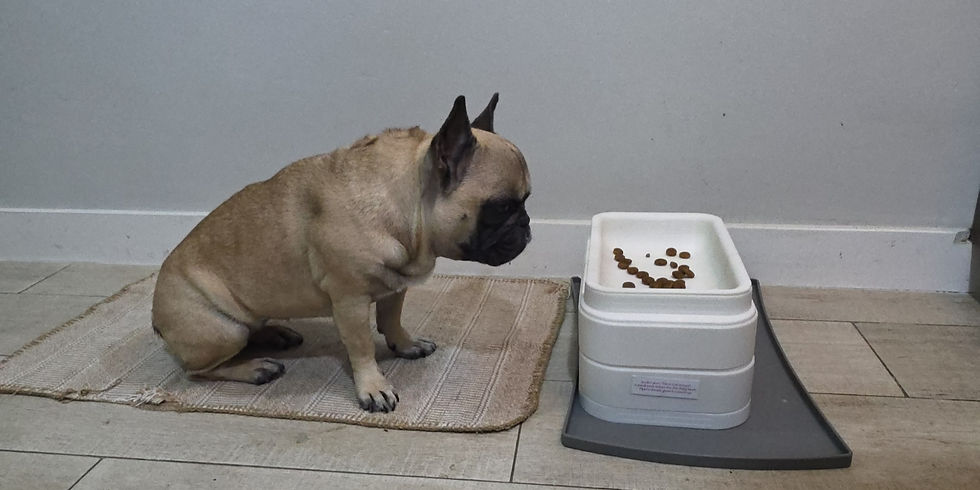
My dog Piper is a rescue French Bulldog. She was born with a cleft palate and was tube fed every two hours as a puppy. She had aspiration pneumonia as an infant dog, has a crooked spine, had a grade 3 luxating patella, and her physiotherapist recommended elevated feeding for her specifically. When I could not find a feeder that adapted as her needs changed, I stopped looking for a solution and built one instead. As I said on our own podcast: "Feeding posture isn't just neutral. It's a movement pattern. It is something that is repeated every single day." A dog eats roughly 8,000 meals over an average lifetime. That is 8,000 repetitions of whatever posture you set up for them. I would rather it be the right one from the start, and it is exactly why we designed Élevé, our own elevated feeder, to be height adaptive rather than fixed. As I put it on the podcast: "Not because everyone needs it, but because some dogs really do."
FAQ
Do French Bulldogs actually need an elevated bowl, or is this just marketing?
Not every French Bulldog needs one, but the breed's anatomy (restricted airway, higher documented rate of aspiration pneumonia, and common orthopedic issues) means feeding posture is worth more attention for this breed group than for an average dog. It is a low risk, evidence informed change, not a cure all.
Is bloat a concern with elevated bowls for French Bulldogs?
The bloat (GDV) concern associated with raised feeders in older research applies specifically to large and giant deep chested breeds like Great Danes and Weimaraners. French Bulldogs are not a deep chested breed in that sense, so this specific risk profile does not typically apply the same way. If you are unsure, ask your vet.
My French Bulldog gulps food fast. Will an elevated bowl fix that?
An elevated bowl addresses posture, not eating speed on its own. Pairing an adjustable height bowl with a slow feed insert addresses both the gulping and the neck angle at the same time.
At what age should I start using an elevated bowl?
There is no need to wait for a diagnosis. If your Frenchie is a puppy, an adjustable bowl that grows with them avoids buying a new one every few months and gets the posture right from day one.
Can an elevated bowl help with regurgitation or reflux in my French Bulldog?
It may help by reducing the gulping and sharp downward bend that can contribute to reflux and regurgitation in flat faced breeds. If regurgitation is frequent, that is a conversation for your vet first, since it can also signal issues like megaesophagus or BOAS related complications that need direct treatment.
What is the difference between a slow feeder and an elevated bowl?
A slow feeder uses ridges or obstacles to physically slow down how fast a dog can eat. An elevated bowl changes the height and angle of the eating position. They solve different problems and work well combined, which is why some feeders, including ours, offer both in one system.
Where can I read more about brachycephalic airway syndrome in French Bulldogs?
The VCA Animal Hospitals overview is a solid, plain language starting point, and the JAVMA study on aspiration pneumonia in brachycephalic breeds covers the clinical data referenced above. Dr. Jane Ladlow is an experienced European and Royal College Specialist in small animal surgery with a thorough knowledge of brachycephalic obstructive airway syndrome and has a number of peer reviewed studies that can be very helpful as well.
About the Author:
Mariska Nell is the founder of Tails & Tones and host of the Tails & Tones podcast, where she interviews veterinary specialists about canine comfort, mobility, and everyday care. She holds a Master's in Sustainable Design and a postgraduate qualification in Environmental Science, and lives in Dubai with Piper, a rescue French Bulldog and the reason Élevé exists.

Comments